
Candid photography is all about capturing raw, unfiltered emotions and authentic moments. However, even the most spontaneous shots need strong composition to make them visually striking. Without intentional framing and balance, even the most genuine moments can appear chaotic or unappealing.
Table of Contents
Introduction
Candid photography is all about capturing raw, unfiltered emotions and authentic moments. However, even the most spontaneous shots need strong composition to make them visually striking. Without intentional framing and balance, even the most genuine moments can appear chaotic or unappealing.
Composition plays a crucial role in drawing attention to the subject, guiding the viewer’s eye, and enhancing storytelling. Whether you’re shooting street photography, portraits, or event coverage, understanding compositional techniques will help you elevate your candid shots.
This in-depth guide explores how composition affects candid photography, breaking down techniques such as the rule of thirds, leading lines, framing, and perspective. By mastering these elements, you can capture stunning, dynamic, and emotionally resonant candid shots.
Whether you’re planning a pre-wedding session, a romantic outdoor shoot, or capturing everyday moments together, understanding the right poses can make your photos look more natural and memorable. Explore these couple pose ideas to discover creative, candid, and romantic poses for every type of photoshoot.
Whether you’re photographing an engagement session or a casual couple shoot, following professional photography best practices can help create more natural interactions and consistently stronger images.
Why Composition Matters in Candid Photography
Brings Order to Chaos
Candid photography often takes place in dynamic environments—crowded streets, social gatherings, or everyday life scenes. Composition helps structure these elements, ensuring the subject remains the focal point amidst the movement.
Creates Visual Impact
A well-composed image captures attention immediately. It guides the viewer’s eye, establishes depth, and enhances storytelling. Without composition, even the most emotionally powerful scene can feel disorganized.
Strengthens Storytelling
Great candid shots narrate a story without words. Composition techniques like symmetry, depth, and framing create an emotional connection between the viewer and the image, making the story more engaging.
Key Composition Techniques for Candid Shots
1. The Rule of Thirds
The rule of thirds is one of the most fundamental principles of photography composition. Instead of centering your subject, divide your frame into a 3×3 grid and place the subject along one of the intersecting points.
Why It Works
- Adds balance and natural flow
- Prevents the image from feeling static
- Creates a visually dynamic scene
How to Apply It
- Enable the grid option on your camera or smartphone
- Position your subject slightly off-center
- Use leading lines to direct attention toward the subject
2. Leading Lines
Leading lines are natural lines within a scene that direct the viewer’s eye toward the subject. These can be roads, fences, staircases, or even shadows.
Why It Works
- Guides focus effortlessly
- Adds depth and dimension
- Enhances storytelling by leading viewers through the frame
How to Apply It
- Identify strong lines in your environment before shooting
- Position yourself so the lines direct attention to your subject
- Experiment with diagonal lines for dynamic compositions
3. Framing Your Subject
Framing involves using surrounding elements—such as doorways, windows, trees, or even people—to create a natural border around the subject.
Why It Works
- Draws immediate focus to the subject
- Adds depth and perspective
- Creates a storytelling element by showing the subject in context
How to Apply It
- Look for natural frames in the environment
- Use foreground elements to add a layered effect
- Adjust your angle to ensure the frame enhances rather than distracts
4. Negative Space for Simplicity
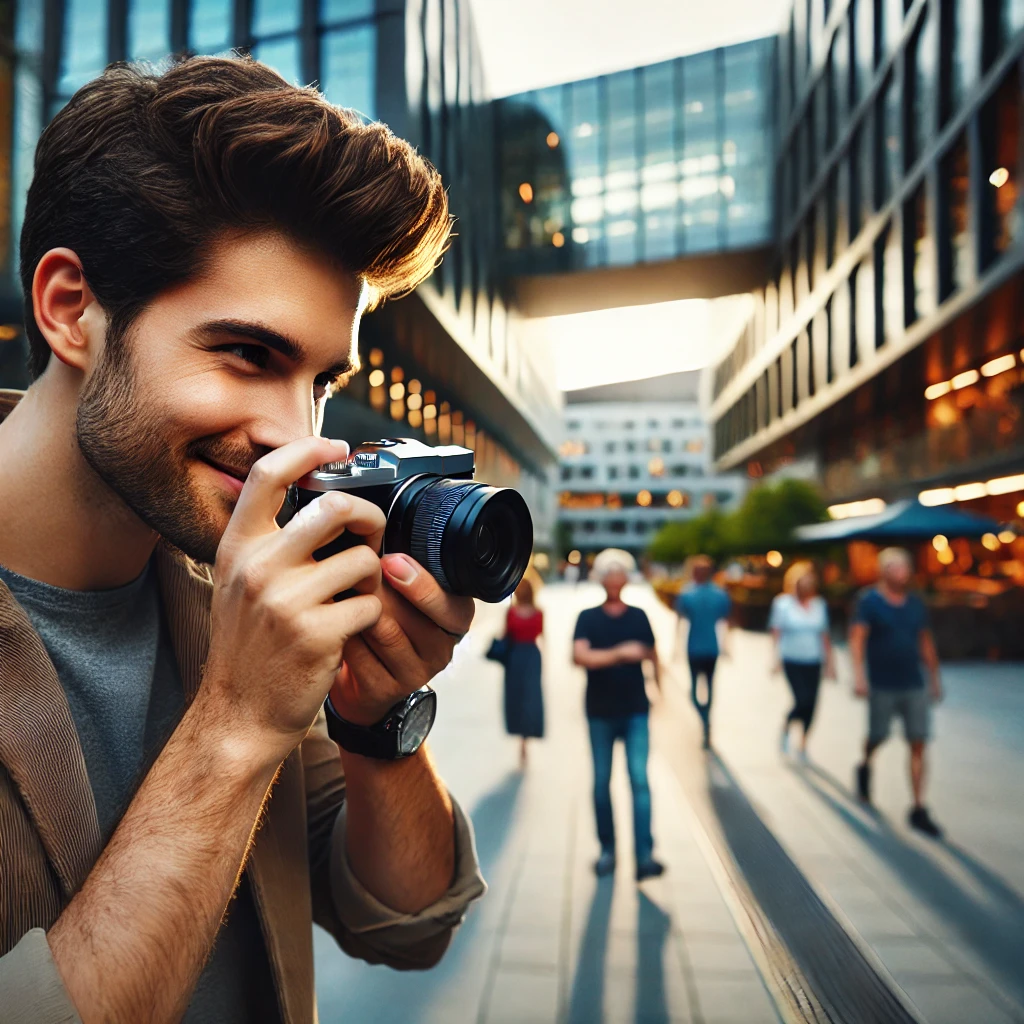
Negative space refers to the empty or less busy areas around your subject. Using negative space in candid photography helps the subject stand out while evoking emotion.
Why It Works
- Creates a minimalist, impactful composition
- Prevents distractions and visual clutter
- Evokes a sense of solitude or introspection
How to Apply It
- Position your subject against a plain background
- Use open spaces such as the sky, walls, or water
- Balance the subject and empty space for harmony
5. Depth and Layering
Depth in photography gives images a three-dimensional feel. By including elements in the foreground, midground, and background, you create a sense of space that makes candid shots more immersive.
Why It Works
- Enhances realism and storytelling
- Makes the photo visually rich and engaging
- Leads the eye through different layers
How to Apply It
- Use objects in the foreground to create depth
- Adjust your aperture (wide for blurred backgrounds, narrow for deep focus)
- Experiment with different perspectives to highlight layers
6. Golden Ratio (Fibonacci Spiral)
The golden ratio is a more advanced form of the rule of thirds, creating a spiral pattern that naturally guides the eye toward the subject.
Why It Works
- Mimics natural aesthetic harmony found in nature
- Creates a balanced yet dynamic composition
- Leads the viewer’s eye smoothly through the scene
How to Apply It
- Use the Fibonacci spiral overlay available in some editing software
- Place your subject near the tightest part of the spiral
- Align surrounding elements to complement the curve
7. Symmetry and Reflections
Symmetry creates visually pleasing and balanced compositions. Reflections in water, mirrors, or glass can enhance symmetry while adding depth.
Why It Works
- Provides a sense of harmony and stability
- Captures the viewer’s attention immediately
- Works well in architectural and environmental shots
How to Apply It
- Look for natural symmetry in architecture, streets, or nature
- Use reflections in puddles, mirrors, or glass windows
- Center your subject if symmetry is the main focus
8. Perspective and Angles
Changing your perspective can drastically impact the composition. Shooting from high above, down low, or through obstacles adds uniqueness to your candid shots.
Why It Works
- Provides fresh and unexpected viewpoints
- Makes the image more engaging and immersive
- Highlights details often overlooked
How to Apply It
- Crouch low or shoot from a high vantage point
- Capture over-the-shoulder perspectives for a storytelling effect
- Experiment with unconventional angles for creativity
Applying Composition in Different Candid Photography Settings
Street Photography
- Use leading lines from roads, sidewalks, or building edges
- Capture depth by layering pedestrians, vehicles, and urban elements
- Frame subjects with doorways, shop windows, or alleyways
Event Photography
- Utilize negative space to separate key moments from the crowd
- Use symmetry in formal gatherings, ceremonies, or dance performances
- Shoot over shoulders for an immersive, first-person perspective
Travel and Cultural Photography
- Capture local traditions using the rule of thirds for balance
- Frame subjects naturally through archways, trees, or market stalls
- Emphasize scale by contrasting people against large landmarks
Family and Social Gatherings
- Use depth and layering to show interactions between people
- Capture emotions naturally by framing subjects subtly
- Apply leading lines from table settings or room arrangements
Post-Processing for Stronger Composition
While strong composition starts in-camera, post-processing can refine it further.
Cropping for Balance
- Adjust framing if elements are distracting
- Enhance symmetry by aligning horizons and vertical lines
Enhancing Depth and Contrast
- Use light and shadow adjustments to highlight subject focus
- Add subtle vignettes to draw attention inward
Black and White for Emphasis
- Monochrome images emphasize composition by removing color distractions
- Works well for candid shots with strong contrast and emotion
Conclusion
Composition is the backbone of stunning candid shots. By mastering techniques like the rule of thirds, leading lines, framing, and depth, photographers can create visually compelling and emotionally engaging images. The more intentional you become with composition, the stronger your candid photography will be—transforming everyday moments into timeless storytelling.
About The Candid Shoot
The Candid Shoot is an independent photography resource dedicated to helping photographers, creators, couples, models, brands, and photography enthusiasts make better decisions and create better images.
Our content covers practical photography techniques, camera and equipment guidance, posing ideas, portrait and fashion photography, product photography, AI photography tools, and photography workflows.
We focus on practical, experience-informed guidance rather than simply repeating generic information found across the web. Our goal is to make photography easier to understand, easier to apply, and more useful in real-world situations.
Why Trust The Candid Shoot?
We build our articles around a simple editorial principle: useful information first, clear explanations second, and unnecessary hype last.
Our articles are developed with attention to:
- Practical photography use cases and real-world shooting situations
- Camera, lens, software, and photography workflow considerations
- Clear explanations for beginners while retaining useful information for experienced creators
- Current tools, techniques, and photography trends where relevant
- Comparisons of advantages, limitations, features, and practical applications
- Original editorial organization instead of simply rewriting existing articles
- Internal linking to related photography resources so readers can explore a topic in depth
Our objective is not to recommend something simply because it is popular. We aim to explain when a technique, tool, workflow, or approach makes sense — and when it may not.
Our Editorial Process
Every article published on The Candid Shoot follows a structured editorial process designed to improve accuracy, usefulness, and clarity.
Research: We review relevant photography concepts, tools, techniques, product information, and established industry resources before developing an article.
Practical Evaluation: Information is considered from the perspective of actual photography use cases, including shooting conditions, workflow, composition, posing, editing, equipment selection, and creator needs.
Editorial Development: We organize information into clear sections, practical explanations, examples, recommendations, and actionable takeaways.
Fact Checking: Technical claims, specifications, terminology, and important factual information are checked against reliable sources where appropriate.
Reader-First Review: We evaluate whether the article actually answers the search intent, whether the recommendations are understandable, and whether the content provides useful next steps.
Ongoing Updates: Articles may be reviewed and updated when photography technology, software, equipment, techniques, or industry practices change.
Our Editorial Standards
The Candid Shoot aims to keep its editorial content:
Accurate: We work to verify important technical and factual information.
Useful: Information should help the reader solve a real photography problem or make a better decision.
Transparent: We distinguish educational guidance, editorial opinions, comparisons, and factual information.
Practical: Wherever possible, we focus on how photography concepts can actually be applied.
Independent: Articles are created to serve readers first rather than simply promote a product, technique, or trend.
Sources & Photography Resources
We believe readers should be able to continue their research. Depending on the topic, our articles may reference or recommend authoritative photography and technology resources.
Useful external resources may include:
- Adobe Photography
- Adobe Lightroom
- Nikon Learn & Explore
- Canon Learning
- Sony Alpha Universe
- Google Search Central
- Google AI
- OpenAI
External links are included where they provide additional context, technical information, official documentation, or useful learning resources.
Explore More From The Candid Shoot
Continue learning through our photography resources:
Photography Tutorials:
https://thecandidshoot.com/category/photography-tutorials/
Couple Photography:
https://thecandidshoot.com/category/couple-photography/
Camera & Equipment:
https://thecandidshoot.com/category/camera-equipment/
Portrait & Fashion Photography:
https://thecandidshoot.com/category/portrait-fashion-photography/
Product Photography:
https://thecandidshoot.com/category/product-photography/
AI Photography:
https://thecandidshoot.com/category/ai-photography/
Photography Guides & Resources:
https://thecandidshoot.com/
Reader Feedback & Reviews
The Candid Shoot values feedback from photographers, creators, and readers who use our guides in their own work.
Reader questions and feedback help us identify confusing topics, missing information, outdated recommendations, and areas where an article can become more useful.
We continually use this feedback to improve the quality, clarity, and practical value of our photography resources.
Editorial Note
Photography is highly dependent on the subject, lighting conditions, equipment, creative goals, budget, and shooting environment. Recommendations that work for one photographer may not be ideal for another.
For that reason, The Candid Shoot focuses on explaining the reasoning behind a recommendation instead of presenting every technique, product, or workflow as universally suitable.
Related Articles
Continue exploring The Candid Shoot’s photography guides:
- 25 Essential Photography Tutorials for Beginners
Learn the fundamentals of photography, camera settings, exposure, lenses, and essential techniques. - 25 Essential Camera & Equipment Buying Secrets
Understand cameras, lenses, sensors, autofocus, and how to choose photography equipment wisely. - 35 Powerful Portrait & Fashion Photography Secrets
Explore portrait composition, lighting, posing, cameras, and fashion photography techniques. - 45 Powerful Product Photography Secrets
Discover practical product photography techniques, lighting setups, equipment, and creative ideas. - 30 Easy Couple Poses for Photoshoot at Home
Find simple, romantic, candid, and creative couple poses for indoor and outdoor photoshoots. - How to Use Golden Hour for Stunning Travel Photos
Learn how golden-hour lighting can improve portraits, landscapes, travel photos, and outdoor photography. - AI Photography Guide: Powerful Tools and Tips
Explore AI photography tools, editing workflows, image enhancement, and practical AI techniques. - Couple Photography Guide
Explore more couple photography ideas, posing guides, romantic concepts, and creative photoshoot inspiration. - Photography Tutorials
Browse practical photography tutorials covering camera techniques, composition, lighting, editing, and beginner guidance. - Camera & Equipment Guides
Explore camera buying guides, lenses, equipment comparisons, photography gear, and technical resources.
Last reviewed: [August, 2026]
Editorial team: The Candid Shoot Editorial Team





Leave a Reply