
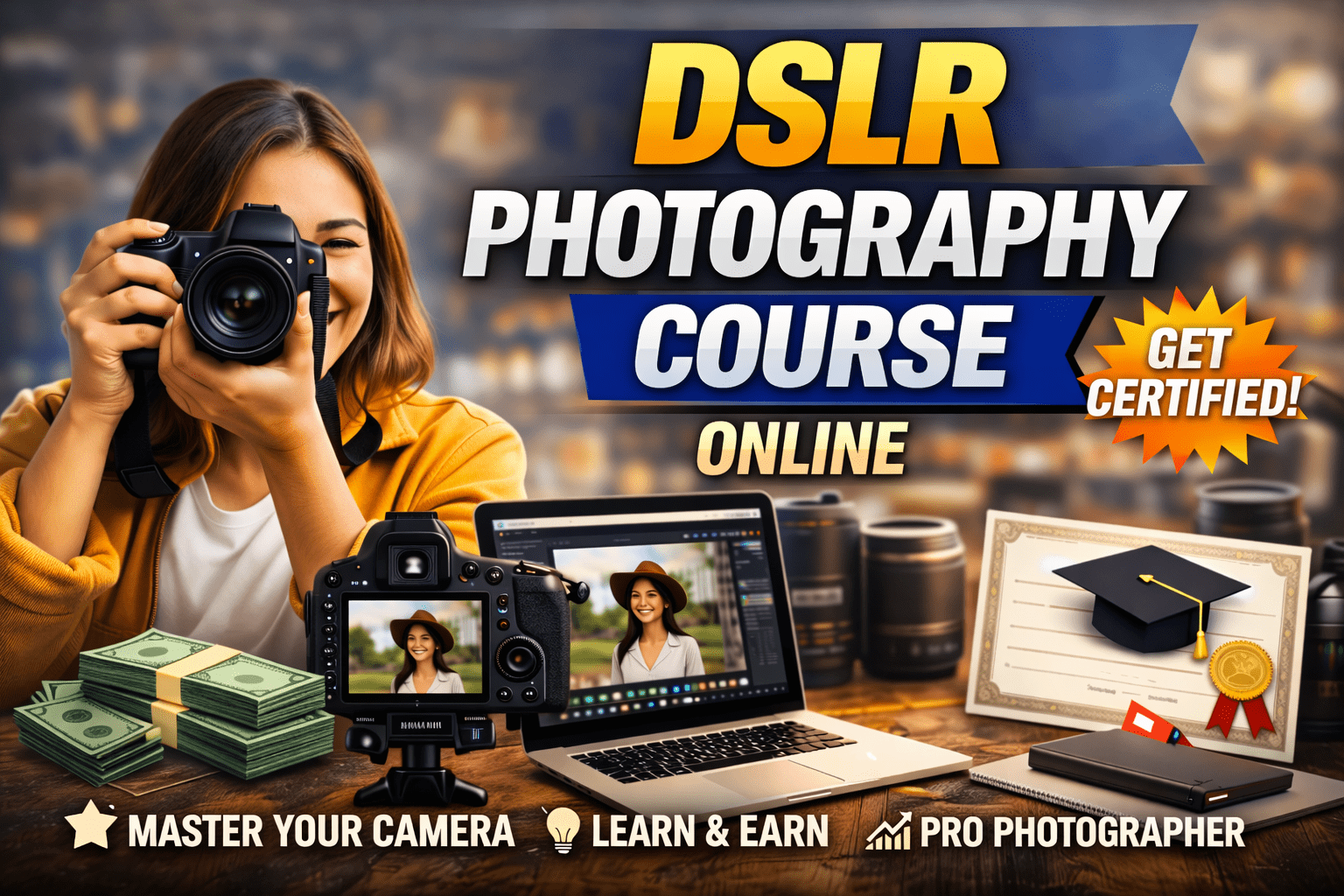
Discover the best DSLR photography courses online. Learn camera settings, lighting, editing, and start your photography career with certification.
Why DSLR Photography Still Matters in 2026
Despite rapid advancements in smartphone cameras, DSLR photography continues to dominate the professional space. Photographers still rely on DSLRs for their superior image quality, lens flexibility, manual control, and reliability in diverse shooting conditions.

At the same time, learning DSLR photography has become more accessible. You no longer need to attend expensive institutes or invest in offline training programs. Online DSLR photography courses now provide structured learning, practical assignments, and career-focused guidance.
However, many beginners struggle because they:
- Use auto mode without understanding camera settings
- Watch random tutorials without structure
- Avoid practicing consistently
- Ignore editing and lighting
This guide solves those problems by giving you a complete roadmap.
By the end of this article, you will understand:
- What a DSLR photography course includes
- How to master DSLR camera settings
- Which skills matter for professional photography
- How to turn DSLR skills into income
What Is a DSLR Photography Course Online ?
A DSLR photography course online is a structured training program designed to help you learn how to use a DSLR camera professionally.
Unlike scattered YouTube videos, a proper course follows a step-by-step system:
Learning Framework
- Understanding camera basics
- Learning manual mode
- Mastering composition and lighting
- Editing and post-processing
- Building a portfolio
This structured approach helps you avoid confusion and progress faster.
What You Will Learn in a DSLR Photography Course
1. Understanding Your DSLR Camera (Foundation Level)
Before capturing professional photos, you must understand how your camera works.
Key Components Explained in Detail
Camera Body
The main structure that holds all controls and settings.
Lens
The most important part of your setup. It determines:
- Sharpness
- Depth of field
- Perspective
Sensor
The sensor captures light and converts it into an image. Larger sensors produce better image quality.
Viewfinder and LCD Screen
Used for framing and reviewing images.
Why This Matters
Once you understand your camera, you stop guessing and start shooting with intention.
2. Mastering Manual Mode (Core Skill for Professionals)
Manual mode gives you full creative control.
The Exposure Triangle Explained in Depth
ISO (Sensitivity to Light)
ISO affects brightness and image quality.
- ISO 100–200: Best for daylight, clean images
- ISO 800+: Useful in low light but adds grain
Shutter Speed (Motion Control)
Shutter speed controls how motion appears in your photo.
- Fast (1/1000): Freezes action (sports, wildlife)
- Slow (1/10): Creates motion blur (waterfalls, light trails)
Aperture (Depth and Light Control)
Aperture controls background blur and light entry.
- f/1.8: Blurred background (portrait photography)
- f/11: Sharp background (landscape photography)
Practical Example
To capture a sharp portrait with blurred background:
- Use wide aperture (f/1.8–f/2.8)
- Keep ISO low
- Adjust shutter speed for proper exposure
3. Composition Techniques (Turning Photos into Visual Stories)
Composition is what makes your photo visually appealing.
Detailed Composition Techniques
Rule of Thirds
Divide your frame into nine parts and place your subject strategically.
Leading Lines
Guide the viewer’s eye through the image.
Framing
Use objects like windows or trees to frame your subject.
Depth Creation
Add foreground, midground, and background for dimension.
Real-World Insight
Professional photographers rarely rely on luck. They intentionally compose every shot.
4. Lighting Techniques (The Biggest Differentiator)
Lighting defines the quality, mood, and impact of your image.
Types of Lighting Explained
Natural Light
- Soft light (morning/evening) → best for portraits
- Harsh light (midday) → creates strong shadows
Golden Hour Photography
The golden hour produces warm tones and soft shadows.
Artificial Lighting
Includes:
- Studio lights
- Flash
- Reflectors
Beginner Tip
Always observe how light falls on your subject before taking a shot.
5. Lens Selection and Usage (Advanced Understanding)
Your lens choice significantly affects your output.
Types of Lenses Explained
Prime Lens
- Fixed focal length
- Sharp image quality
- Ideal for portraits
Zoom Lens
- Flexible focal range
- Suitable for travel and events
Wide-Angle Lens
- Captures more area
- Best for landscapes
Why It Matters
The right lens can instantly improve your photography.
6. Photo Editing and Workflow Optimization
Editing is an essential part of professional photography.
Detailed Editing Process
- Import photos
- Adjust exposure
- Correct colors
- Retouch details
- Export final images
Tools You Will Learn
- Adobe Lightroom
- Photoshop
Pro Tip
Consistency in editing creates a recognizable style.
7. Practical Assignments and Portfolio Building
Practice is what turns knowledge into skill.
Example Assignments
- Portrait photography in natural light
- Product photography at home
- Landscape photography during sunset
Portfolio Building Strategy
- Select your best work
- Create an online portfolio
- Showcase variety
Best DSLR Photography Courses Online (2026 Detailed Analysis)
1. Complete DSLR Photography Masterclass
Best For
Beginners who want a complete roadmap.
What You Learn
- Camera basics
- Manual mode
- Composition
2. Advanced DSLR Photography Course
Focus
- Professional lighting
- Commercial shoots
- Advanced techniques
3. DSLR + Editing Course
Includes
- Shooting techniques
- Editing workflows
4. DSLR Business Course
Focus
- Freelancing
- Client acquisition
- Pricing strategies
Case Study 1: Beginner to ₹30,000/Month Freelancer
Rohit started with a basic DSLR and an online course.
Execution Plan
- Practiced daily
- Built a portfolio
- Promoted work online
Result
He started getting paid projects within 5 months.
Case Study 2: Building a Photography Brand
Sneha focused on product photography.
Strategy
- Collaborated with small brands
- Built Instagram presence
Outcome
She created a stable income stream.
Benefits of DSLR Photography Courses Online
Flexible Learning
Learn anytime without restrictions.
Cost-Effective
Much cheaper than offline courses.
Access to Experts
Learn from professionals worldwide.
Faster Skill Development
Structured learning speeds up progress.
How to Choose the Best DSLR Photography Course
1. Define Your Goal
Career, freelancing, or hobby.
2. Check Course Content
Ensure it includes practical training.
3. Look for Certification
Useful for credibility.
4. Read Reviews
Understand course quality.
Career Opportunities After DSLR Course
Freelance Photography
Work independently and choose projects.
Wedding Photography
High-paying niche.
Product Photography
Work with brands and e-commerce stores.
Content Creation
Create visuals for social media.
Stock Photography
Earn passive income.
Common Mistakes Beginners Should Avoid
- Using auto mode only
- Ignoring lighting
- Not practicing enough
- Skipping editing
Future of DSLR Photography
DSLR photography remains relevant due to:
- Professional demand
- Creative control
- High-quality output
Conclusion: Start Your DSLR Journey Today
A DSLR photography course online provides a complete roadmap to success. It helps you master your camera, develop creativity, and build a profitable career.
Start today, practice consistently, and focus on improvement. Your journey to becoming a professional photographer begins now.
FAQ Section
Which DSLR course is best for beginners?
A complete DSLR masterclass covering basics to advanced topics is ideal.
Can I learn DSLR photography online?
Yes. Online courses provide structured and practical learning.
How long does it take to learn DSLR photography?
You can learn basics in weeks and become job-ready in 3–6 months.
Do I need expensive gear?
No. Entry-level DSLRs are sufficient.
Can I earn money after learning DSLR photography?
Yes. Many photographers earn through freelancing and events.
The Candid Shoot
Ready to master your DSLR camera and start earning?
Enroll in a DSLR photography course online today and turn your passion into a professional career.


Leave a Reply