
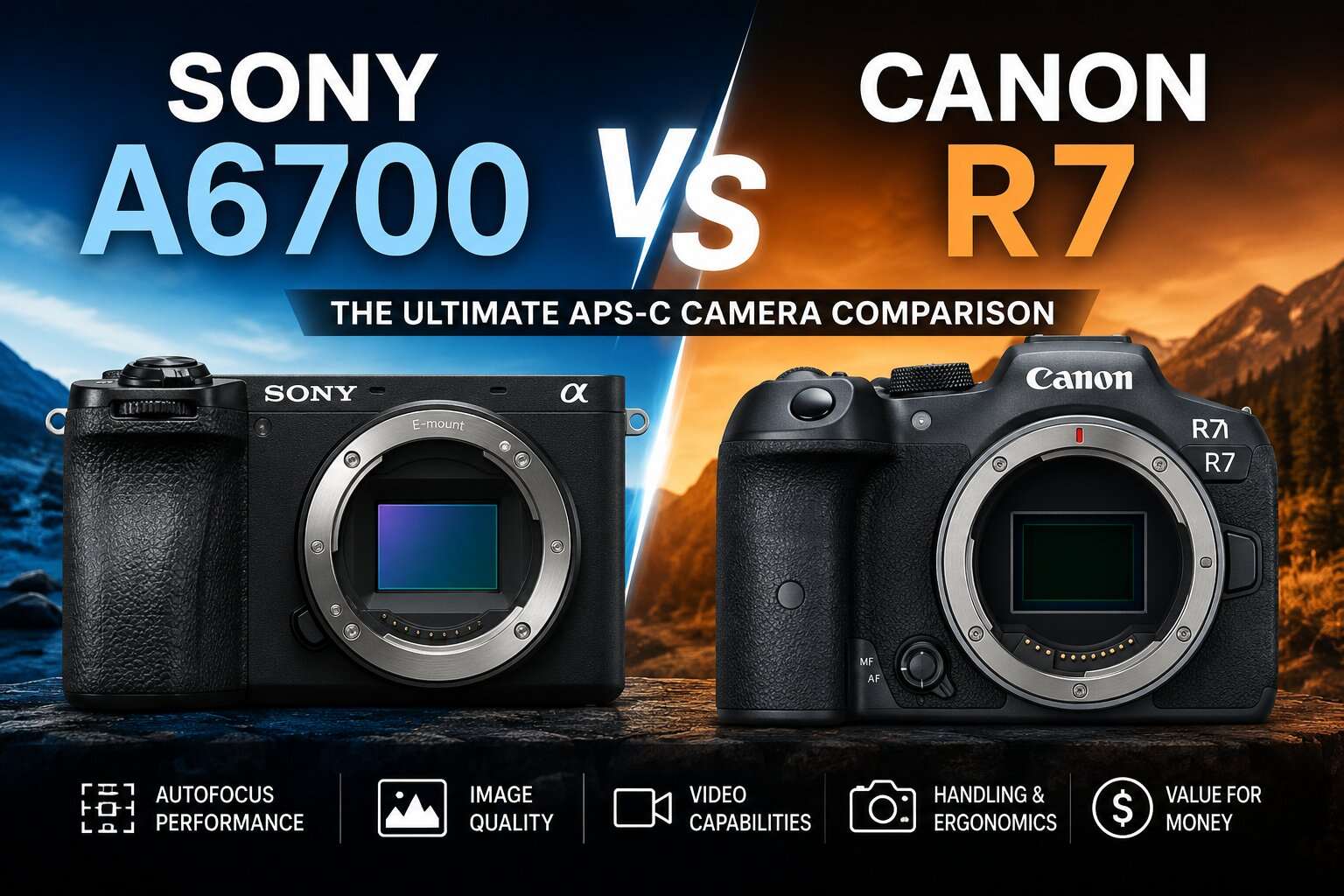
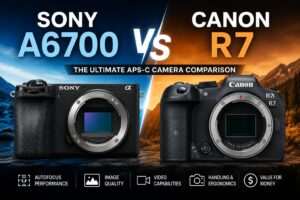
Sony A6700 vs Canon R7 compared for image quality, autofocus, wildlife, video, battery, lenses, and value. Find out which APS-C camera is right for you.
Table of Contents
Introduction
Choosing between the Sony A6700 and Canon EOS R7 is difficult because both are serious APS-C mirrorless cameras, but they prioritize slightly different types of photographers.
The Sony A6700 combines a 26MP back-illuminated APS-C sensor, sophisticated subject-recognition autofocus, 5-axis stabilization, 10-bit video, and a compact 493g body. The Canon R7 counters with a higher-resolution 32.5MP sensor, faster mechanical shooting, stronger rated IBIS performance, dual UHS-II card slots, and a more traditional enthusiast-camera design.
So which one should you buy?
The Sony A6700 is the better all-around hybrid for photographers who prioritize autofocus, video, travel, compact size, and access to Sony’s broad E-mount ecosystem.
The Canon R7 is the stronger choice for wildlife and action photographers who value resolution, fast burst shooting, dual card slots, and Canon’s RF system.
The important point is that neither camera wins every category. Your shooting style should determine the winner.
25 Essential Camera & Equipment Buying Secrets Every Photographer
Quick Answer
If you want the shortest possible answer:
| If you care most about… | Better choice |
|---|---|
| Autofocus tracking | Sony A6700 |
| Wildlife/action burst shooting | Canon R7 |
| Resolution and cropping | Canon R7 |
| Video flexibility | Sony A6700 |
| 4K slow motion | Sony A6700 |
| Battery life | Sony A6700 |
| Dual card slots | Canon R7 |
| Compact travel setup | Sony A6700 |
| Traditional controls and handling | Canon R7 |
| Lens ecosystem flexibility | Sony A6700 |
| Wildlife value | Canon R7 |
| Hybrid photo/video use | Sony A6700 |
Overall winner for most hybrid photographers: Sony A6700.
Best specialist choice for wildlife and fast action: Canon R7.
Check Current Prices
If you’re deciding between the Sony A6700 and Canon EOS R7, checking the latest price and availability can help you make the final decision.
Sony A6700 — Check Current Price on Amazon
Canon EOS R7 — Check Current Price on Amazon
Affiliate disclosure: The links above are affiliate links. If you make a qualifying purchase through them, The Candid Shoot may earn a commission at no additional cost to you.
Editorial Approach
This comparison evaluates manufacturer specifications from Sony and Canon alongside independent camera testing and comparison data from DPReview.
Specifications such as resolution, autofocus points, stabilization ratings, burst rates, card support, battery ratings, dimensions, and video capabilities are based primarily on manufacturer documentation. Independent observations about autofocus performance, image quality, handling, and practical use are distinguished from manufacturer claims.
The recommendations in this article are intended for photographers, wildlife shooters, content creators, travelers, enthusiasts, and hybrid shooters deciding between these two APS-C systems.
There is no claim of hands-on testing by The Candid Shoot. Performance can also vary depending on the lens, subject, lighting, firmware, shooting settings, memory card, and photographer.
Sony A6700 vs Canon R7: Key Differences
At first glance, these cameras appear very similar. Both use APS-C sensors, offer in-body stabilization, advanced autofocus, electronic viewfinders, articulating screens, and strong video features.
The differences become more important once you look at how each camera is designed to be used.
Sony A6700
Sony built the A6700 as a compact hybrid camera.
Its 26MP BSI APS-C sensor is paired with the BIONZ XR processor and a dedicated AI processing unit for subject recognition. Sony lists up to 759 phase-detection AF points for stills, 11 fps continuous shooting, 5-axis stabilization, and a 550/570-shot CIPA battery rating depending on whether you use the EVF or LCD.
It also provides 10-bit recording and 4K recording up to 60p, plus 4K up to 120p with a crop.
That combination makes the A6700 particularly attractive to photographers who shoot both stills and video.
Canon EOS R7
Canon takes a slightly different approach.
The R7 uses a 32.5MP APS-C sensor and DIGIC X processing. It can shoot at up to 15 fps with its mechanical shutter and up to 30 fps electronically. Canon also gives the R7 5-axis IBIS, with coordinated stabilization rated up to 7 stops under specified conditions.
The camera has two UHS-II SD card slots, which is a major advantage for photographers who need redundancy during professional assignments.
Sony A6700 vs Canon R7: Specifications
| Feature | Sony A6700 | Canon EOS R7 |
| Sensor | 26MP APS-C BSI CMOS | 32.5MP APS-C CMOS |
| Processor | BIONZ XR + AI processing unit | DIGIC X |
| Lens mount | Sony E | Canon RF |
| Stabilization | 5-axis, 5 stops | 5-axis, up to 7 stops with compatible lenses |
| Max mechanical burst | 11 fps | 15 fps |
| Max electronic burst | 11 fps | Up to 30 fps |
| Stills AF points | Up to 759 phase-detection points | Up to 651 AF zones |
| Subject recognition | Human, animal, bird, insect, car, train, airplane | People, animals, vehicles |
| Video | Up to 4K/120p with crop | Up to 4K/60p |
| 10-bit video | Yes | Yes |
| Log video | S-Log/HLG | Canon Log 3 |
| Card slots | 1 × SD UHS-II | 2 × SD UHS-II |
| Battery rating | Approx. 550 EVF / 570 LCD | LP-E6NH battery |
| Body weight | Approx. 493g with battery/card | Approx. 612g with battery/card |
| Screen | 3-inch vari-angle touchscreen | 3-inch vari-angle touchscreen |
| EVF | 2.36M dots | 2.36M dots |
| Headphone jack | Yes | Yes |
| Microphone jack | Yes | Yes |
Sony’s official specifications list 26MP resolution, 759 phase-detection points, 11 fps shooting, 5-stop stabilization, one UHS-II SD slot, and the 493g body-with-battery/card weight. Canon lists 32.5MP resolution, 651 still-image AF zones, 15 fps mechanical shooting, 30 fps electronic shooting, and approximately 612g with battery and memory card.
Where to Buy the Sony A6700 and Canon R7
If you’ve narrowed your choice down to these two cameras, you can check their current availability and pricing on Amazon before making your purchase.
| Camera | Best For | Check Price |
|---|---|---|
| Sony A6700 | Hybrid photography, video, travel, content creation | Check Sony A6700 on Amazon |
| Canon EOS R7 | Wildlife, action, high-resolution APS-C photography | Check Canon R7 on Amazon |
Affiliate disclosure: The links in this section are affiliate links. The Candid Shoot may earn a commission from qualifying purchases at no additional cost to you.
Image Quality: Sony A6700 vs Canon R7
Canon R7 wins on resolution
The Canon R7 has a clear numerical advantage with its 32.5MP sensor compared with the A6700’s 26MP sensor.
That extra resolution matters most when you crop photographs.
For example, wildlife photographers often photograph animals that remain relatively small in the frame. A higher-resolution file can provide more flexibility when cropping while retaining useful detail.
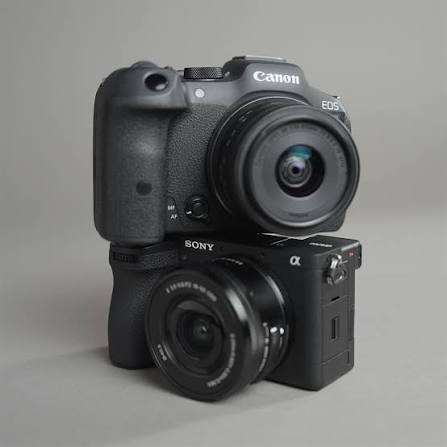
Canon specifically describes the R7’s APS-C sensor as useful for achieving telephoto reach and capturing fast-moving subjects.
Sony A6700 still produces excellent image quality
The A6700’s lower pixel count does not make it a low-quality camera.
Its 26MP BSI CMOS sensor provides plenty of resolution for:
- Portrait photography
- Travel photography
- Social media
- Editorial photography
- Commercial content
- YouTube thumbnails
- Prints
- General enthusiast photography
Independent testing by DPReview found the A6700 produced very good image quality, with RAW files offering substantial flexibility.
Check the Sony A6700 Price
If the Sony A6700 fits your photography or video needs, you can check its current price and availability on Amazon.
Affiliate link. We may earn a commission from qualifying purchases at no additional cost to you.
Which has better image quality?
Canon R7 wins for resolution and cropping.
Sony A6700 remains highly competitive for overall image quality.
The difference is not large enough to choose the R7 solely because it has more megapixels unless you regularly crop heavily or need larger files.
Check the Canon EOS R7 Price
If the Canon EOS R7 better matches your needs—particularly for wildlife, action, or high-resolution APS-C photography—you can check its current price and availability on Amazon.
Check Canon EOS R7 on Amazon →
Affiliate link. We may earn a commission from qualifying purchases at no additional cost to you.
Autofocus: Sony A6700 vs Canon R7
This is one of the most interesting categories.
Sony A6700 autofocus
Sony gives the A6700 a dedicated AI processing unit for subject recognition.
It recognizes:
- Humans
- Animals
- Birds
- Insects
- Cars
- Trains
- Airplanes
Sony lists up to 759 phase-detection points for still photography.
Independent testing gives the Sony a major advantage here.
DPReview found the A6700’s subject tracking extremely reliable, including unpredictable movement, and reported particularly strong animal recognition.
Canon R7 autofocus
Canon’s R7 uses Dual Pixel CMOS AF II.
Its subject-detection system can identify people, animals, and vehicles, and Canon lists up to 651 AF zones for still photography.
The R7’s autofocus is highly capable, particularly for action and wildlife.
However, independent testing from DPReview found the Sony A6700’s tracking reliability to be stronger overall, while the Canon compensated with faster burst shooting.
Autofocus winner: Sony A6700
If your priority is subject recognition and tracking reliability, the A6700 gets the edge.
If your priority is capturing more frames per second, the R7 becomes more attractive.
Burst Shooting: Canon R7 Wins
This category belongs to Canon.
The R7 can shoot up to:
- 15 fps mechanically
- 30 fps electronically
Canon also provides RAW Burst functionality with pre-shooting capabilities.
The A6700 reaches approximately 11 fps with its high-speed drive mode.
For birds in flight, motorsports, sports, and rapidly changing action, those extra frames can matter.
Winner: Canon R7
For pure shooting speed, the R7 is the stronger camera.
Wildlife Photography
Both cameras make excellent wildlife cameras.
But they approach wildlife photography differently.
Why choose the Canon R7 for wildlife?
The R7 combines:
- 32.5MP resolution
- APS-C crop factor
- 15 fps mechanical shooting
- 30 fps electronic shooting
- Animal detection
- Strong stabilization
- RF telephoto compatibility
The extra resolution is particularly useful when you need to crop distant animals.
The Candid Shoot’s existing camera buying guide also lists the R7 among recommended wildlife cameras, alongside the Sony A6700.
Why choose the Sony A6700 for wildlife?
Sony’s advantage is autofocus intelligence.
Its subject-recognition system covers animals and birds, while independent testing has found its tracking particularly reliable.
The smaller body can also make a long day of travel and wildlife shooting easier.
Wildlife winner: Canon R7
For a dedicated wildlife photographer, the Canon R7 gets the edge because its higher resolution and faster burst rate complement long-lens shooting extremely well.
But the A6700 remains an excellent wildlife camera, particularly if autofocus tracking and system portability matter more.
Video: Sony A6700 vs Canon R7
This is where the Sony becomes particularly compelling.
Sony A6700 video
The A6700 supports:
- 4K recording up to 60p
- 4K up to 120p with crop
- 10-bit recording
- 4:2:2 options
- S-Log
- HLG
- Active stabilization modes
- Subject recognition during video
Sony also provides features aimed directly at creators, including Auto Framing and a fully articulating screen.
Canon R7 video
The R7 supports 4K60 recording and 10-bit options, along with Canon Log 3 and HDR-PQ.
That makes it a strong hybrid video camera.
However, the Sony’s 4K120 option gives creators more flexibility when slow-motion footage is important.
Video winner: Sony A6700
For hybrid creators, vloggers, YouTubers, and filmmakers, the A6700 is the better choice.
The Canon R7 remains excellent if your video requirements are primarily 4K60 and you place greater emphasis on still photography.
Low-Light Photography
Neither camera is a full-frame body, so photographers should keep expectations realistic.
Both use APS-C sensors and can deliver strong results at higher ISO settings, but lens choice becomes extremely important in difficult lighting.
A fast f/1.4 or f/1.8 lens can make a much bigger practical difference than obsessing over small sensor-to-sensor differences.
DPReview’s testing found the A6700’s mid-to-high ISO performance broadly competitive with the R7.
Winner: Tie
For low-light photography, neither camera has a decisive advantage.
Choose the camera that gives you access to the lenses you actually need.
Image Stabilization
Sony A6700
The A6700 has 5-axis sensor-shift stabilization rated at 5 stops under Sony’s specified testing conditions.
It also offers Active stabilization for video.
Canon R7
The R7 uses 5-axis IBIS and Canon rates coordinated stabilization with compatible RF/RF-S lenses at up to 7 stops under specified conditions.
That makes the Canon particularly attractive for handheld still photography with compatible stabilized lenses.
Winner: Canon R7
On the manufacturer’s rated stabilization figures, the R7 has the advantage.
Remember that stabilization does not freeze moving subjects. It mainly helps compensate for camera movement.
Battery Life
Battery life is another area where the Sony has an advantage on published CIPA numbers.
Sony rates the A6700 at approximately:
- 550 shots using the EVF
- 570 shots using the LCD
using the NP-FZ100 battery.
The Canon R7 uses the larger LP-E6NH battery family, and Canon describes it as offering longer battery life than the smaller-battery EOS R10.
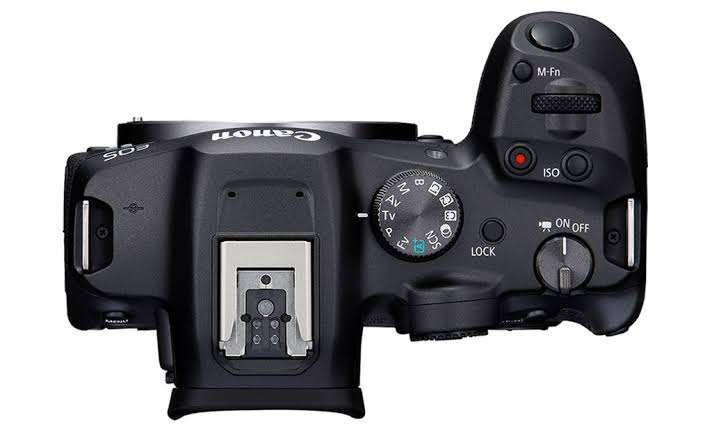
Because battery ratings can vary depending on the exact test method and shooting conditions, direct comparisons should be treated carefully.
Winner: Sony A6700
For the published CIPA still-image figures, the A6700 has the clearer advantage.
Size and Weight
This difference becomes very noticeable when traveling.
The Sony A6700 weighs approximately 493g with battery and memory card.
The Canon R7 weighs approximately 612g with battery and memory card.
That is roughly a 119g difference before adding a lens.
It may not sound significant on paper, but photographers carrying a camera, two lenses, batteries, cards, and accessories all day will notice every gram.
Winner: Sony A6700
For travel, hiking, street photography, everyday photography, and creators who carry their camera frequently, the A6700 is easier to justify.
Lens Ecosystem
This is one of the biggest buying decisions that specifications cannot fully explain.
Sony E-mount
The A6700 uses Sony E-mount.
The platform gives photographers access to a large range of Sony, Sigma, Tamron, Samyang, Viltrox and other compatible lenses.
That flexibility is one of the strongest reasons to choose Sony APS-C.
Canon RF mount
The R7 uses Canon RF mount.
Canon offers RF and RF-S lenses, while EF and EF-S lenses can be used with the appropriate EF-EOS R adapter, subject to Canon’s compatibility restrictions.
Canon’s RF system provides excellent native options, especially for photographers already invested in Canon.
Lens ecosystem winner: Sony A6700
For someone starting a new APS-C system and wanting the broadest range of third-party choices, Sony is generally the safer choice.
For an existing Canon user, however, the calculation can be completely different.
Your existing lenses may matter more than the camera body.
Dual Card Slots: Canon R7 Wins
The Canon R7 has two UHS-II SD card slots.
This matters for professional photographers who want:
- Automatic backup
- Separate RAW/JPEG recording
- More storage
- Greater redundancy during paid assignments
The Sony A6700 has one UHS-II-compatible SD card slot.
Winner: Canon R7
For weddings, paid events, commercial assignments, and other situations where card redundancy matters, the R7’s dual-slot design is a significant advantage.
Handling and Ergonomics
The Canon R7 follows a more traditional DSLR-inspired shape.
That can appeal to photographers who prefer:
- A larger grip
- More physical controls
- Quick access to settings
- A larger body with bigger lenses
The Sony A6700 is smaller and more compact.
It has improved ergonomics compared with older Sony APS-C bodies, but DPReview noted the absence of a dedicated AF joystick as one of its handling compromises.
Handling winner: Canon R7
If you prefer a larger traditional camera body, the R7 is likely to feel more comfortable.
If portability matters more, the A6700 wins.
Sony A6700 vs Canon R7 for Different Types of Photography
Wildlife Photography
Winner: Canon R7
Why:
- 32.5MP resolution
- 15 fps mechanical shooting
- 30 fps electronic shooting
- Animal/vehicle detection
- Strong IBIS
- Excellent cropping potential
The A6700 remains a strong alternative if tracking performance and lighter equipment matter more.
Sports Photography
Winner: Canon R7
The R7’s 15 fps mechanical and 30 fps electronic shooting give it a speed advantage.
However, the A6700’s autofocus tracking is extremely strong.
For unpredictable subjects, Sony’s tracking advantage can partly offset Canon’s speed advantage.
Portrait Photography
Winner: Sony A6700
Both cameras are capable portrait bodies.
The A6700 gets the edge because of its strong human subject recognition, compact body, and broad E-mount lens selection.
For portrait photographers, however, the lens matters enormously.
A high-quality portrait lens can make a larger practical difference than choosing between these two bodies.
Travel Photography
Winner: Sony A6700
The A6700’s smaller 493g body makes it particularly attractive for travel.
It combines:
- Strong autofocus
- Good image quality
- Stabilization
- Excellent video
- Long battery life
- Compact dimensions
The R7 is still an excellent travel camera if you prefer Canon’s handling.
YouTube and Content Creation
Winner: Sony A6700
The A6700’s combination of:
- 10-bit video
- 4K60
- 4K120
- Vari-angle display
- Strong subject tracking
- Active stabilization
- Microphone and headphone connections
makes it especially attractive to hybrid creators.
Professional Event Photography
Winner: Canon R7
This is a qualified recommendation.
The biggest reason is not image quality. It is dual-card redundancy.
If you’re shooting an important paid event, having two cards can provide an additional layer of protection against a card failure.
That said, neither camera would be my first choice for demanding professional wedding work where full-frame performance and dual-card reliability are priorities.
Who Should Buy the Sony A6700?
The Sony A6700 makes the most sense if you:
- Want one camera for both photography and video
- Create YouTube or social media content
- Travel frequently
- Want a lightweight APS-C body
- Prioritize autofocus tracking
- Shoot portraits and people
- Shoot animals and birds
- Want 4K120 slow motion
- Want access to a broad E-mount lens ecosystem
- Prefer a compact setup
- Want strong battery performance
For a creator who shoots photos during the day and video at night, the A6700 is particularly compelling.
Who Should NOT Buy the Sony A6700?
Think twice about the A6700 if you:
- Need dual memory card slots
- Frequently shoot very fast action
- Want 32.5MP files
- Heavily crop wildlife images
- Prefer a larger DSLR-style grip
- Already own several Canon RF lenses
- Want the fastest possible burst rate in this comparison
If you are primarily a wildlife photographer, the R7 deserves serious consideration.
Who Should Buy the Canon R7?
The Canon R7 makes the most sense if you:
- Shoot wildlife
- Photograph birds
- Shoot sports
- Need high-resolution APS-C files
- Crop heavily
- Want 15 fps mechanical shooting
- Need up to 30 fps electronic shooting
- Want dual SD card slots
- Prefer a larger camera body
- Already own Canon RF or compatible EF lenses
- Want strong IBIS performance
Who Should NOT Buy the Canon R7?
The R7 may not be ideal if you:
- Want the smallest possible setup
- Prioritize video over still photography
- Need 4K120
- Want the broadest third-party APS-C lens selection
- Prefer Sony’s subject-tracking system
- Travel with minimal gear
- Prefer a lighter camera body
Sony A6700 Pros and Cons
Pros
- Excellent subject-tracking autofocus
- 26MP BSI APS-C sensor
- Strong image quality
- Compact and lightweight body
- 5-axis IBIS
- Excellent battery rating
- 10-bit video
- 4K120 capability
- Strong creator features
- Broad E-mount ecosystem
Cons
- Only one card slot
- 11 fps maximum burst
- Lower resolution than the R7
- No dedicated AF joystick
- 4K120 comes with a crop
- Smaller body may be less comfortable with large telephoto lenses
Canon R7 Pros and Cons
Pros
- 32.5MP APS-C sensor
- Excellent cropping flexibility
- 15 fps mechanical shooting
- Up to 30 fps electronic shooting
- Strong autofocus
- Up to 7-stop coordinated stabilization with compatible lenses
- Dual UHS-II SD slots
- Excellent wildlife/action credentials
- Comfortable traditional controls
- Canon Log 3 and 10-bit video
Cons
- Heavier than the A6700
- Less compelling for video-first users
- No 4K120 equivalent to the Sony’s 4K120 mode
- RF-S ecosystem is less expansive than Sony’s E-mount third-party ecosystem
- Higher resolution does not automatically mean better image quality
What Should You Consider Before Buying?
Don’t choose between these cameras based only on megapixels.
Consider these factors first.
1. What Do You Photograph?
If you shoot wildlife and sports, the R7’s speed and resolution are valuable.
If you shoot portraits, travel, video, and general photography, the A6700’s balance is excellent.
2. Do You Shoot Video?
If video is a major part of your work, the A6700 deserves serious preference.
Its 4K120 capability, 10-bit recording, creator-oriented features, and strong autofocus make it a more video-focused hybrid.
3. Do You Need Dual Cards?
For professional assignments, the answer may be yes.
The R7 has the advantage here.
4. Do You Crop Wildlife Photos?
If yes, the R7’s 32.5MP sensor is attractive.
More pixels do not automatically produce better photographs, but they can provide more cropping flexibility.
5. Will You Carry the Camera All Day?
If yes, the A6700’s lighter body is worth considering.
The difference is approximately 119g before adding a lens.
6. Which Lens System Fits Your Future?
This is arguably more important than the body.
Before purchasing, research the lenses you expect to own over the next three to five years.
A camera body can be replaced.
A complete lens system is a much larger investment.
Ready to Buy?
The right choice ultimately depends on what you photograph most.
Choose the Sony A6700 if you:
- Want a compact APS-C hybrid camera
- Shoot both photos and video
- Prioritize autofocus and subject tracking
- Want a strong option for travel and content creation
- Prefer Sony’s broad APS-C lens ecosystem
Choose the Canon EOS R7 if you:
- Primarily photograph wildlife or fast-moving subjects
- Want high-resolution APS-C photography
- Prefer Canon’s RF ecosystem
- Value the R7’s crop-sensor reach for telephoto shooting
- Want a camera geared strongly toward action photography
Check Today’s Prices
Sony A6700 → Check Price on Amazon
Canon EOS R7 → Check Price on Amazon
Affiliate disclosure: These are affiliate links. The Candid Shoot may earn a commission from qualifying purchases at no additional cost to you.
Sony A6700 vs Canon R7: Which Is Better for Beginners?
Neither camera is a true entry-level model.
Both offer enough advanced functionality that a beginner could initially feel overwhelmed.
For a beginner who wants to learn photography and video, the Sony A6700 is easier to recommend because it provides a broad hybrid feature set in a relatively compact package.
For someone specifically interested in wildlife photography, the Canon R7 may be the better long-term learning platform because its high-resolution sensor and fast burst shooting encourage action and telephoto work.
Beginner winner: Sony A6700
For a general-purpose beginner.
Wildlife beginner winner: Canon R7
For a beginner specifically focused on wildlife.
Sony A6700 vs Canon R7: Which Is Better for Professionals?
This depends heavily on the job.
For wildlife professionals
Canon R7
For hybrid creators
Sony A6700
For professional event redundancy
Canon R7
For travel content
Sony A6700
For video-first production
Sony A6700
For high-speed action
Canon R7
Neither should automatically be considered a professional camera simply because of its feature list.
Professional suitability depends on reliability, workflow, lenses, accessories, backup strategy, and the demands of the assignment.
Final Buying Checklist
Before purchasing either camera, consider:
- Photography vs video: Which will you do more?
- Subject: Do you primarily shoot people, travel, wildlife, sports, or everyday subjects?
- Lens availability: Which camera system has the lenses you actually need?
- Size and weight: Will you carry the camera regularly?
- Budget: Remember to include the cost of lenses, memory cards, batteries, and other accessories.
- Long-term system: Think beyond the camera body when choosing a camera ecosystem.
Once you’ve made your decision, you can check the current Amazon price:
Affiliate disclosure: The links above are affiliate links. If you make a qualifying purchase, The Candid Shoot may earn a commission at no additional cost to you.
Frequently Asked Questions
Is the Sony A6700 better than the Canon R7?
For most hybrid photographers, yes. The A6700 has excellent autofocus, strong video features, a lighter body, good battery performance, and a broad lens ecosystem.
The R7 is better for photographers who prioritize high resolution, fast burst shooting, wildlife, sports, and dual card slots.
Which has better autofocus, Sony A6700 or Canon R7?
The Sony A6700 has the edge in subject tracking based on independent testing. DPReview found its tracking particularly reliable, including unpredictable subject movement and animal detection.
Is the Canon R7 better for wildlife?
Yes, the R7 is one of the stronger APS-C choices for wildlife because of its 32.5MP sensor, fast shooting speeds, animal detection, and stabilization.
Is the Sony A6700 better for video?
Generally, yes. Its 10-bit recording, 4K60, 4K120 option with crop, strong autofocus, and creator-focused features give it an advantage for hybrid video work.
Which camera has more megapixels?
The Canon R7 has approximately 32.5MP, while the Sony A6700 has approximately 26MP.
Which camera has better stabilization?
Canon has the advantage on the published rated figures. The R7 is rated for up to 7 stops with coordinated IS using compatible lenses, while Sony rates the A6700’s IBIS at 5 stops under its specified CIPA conditions.
Which camera is lighter?
The Sony A6700 is lighter. Sony lists approximately 493g with battery and memory card, while Canon lists approximately 612g for the R7 with battery and memory card.
Which camera has better battery life?
The Sony A6700 has a published CIPA rating of approximately 550 shots using the EVF and 570 using the LCD. The exact real-world result varies with shooting conditions.
Does the Canon R7 have dual card slots?
Yes. The Canon R7 has two UHS-II-compatible SD card slots.
Does the Sony A6700 have 4K120?
Yes. The A6700 can record 4K up to 120p, although Sony specifies a crop in this mode.
Which is better for travel photography?
The Sony A6700 is the better travel choice for most photographers because it is substantially lighter while still providing strong image quality, autofocus, stabilization, battery life, and video features.
Which should I buy if I already own Canon lenses?
If you already have a significant Canon lens collection, the R7 can make more financial sense. The cost of rebuilding a lens system can outweigh the advantages of switching bodies.
Final Verdict
The Sony A6700 vs Canon R7 debate does not have a single winner for every photographer.
The better camera depends on what you actually shoot.
Choose the Sony A6700 if:
- You want the best overall hybrid camera
- Video matters as much as photography
- You want 4K120
- You prioritize autofocus tracking
- You travel frequently
- You want a lighter camera
- You want a broad E-mount lens ecosystem
- You create YouTube, Instagram, or other social content
Choose the Canon R7 if:
- Wildlife is your priority
- You shoot birds or sports
- You need higher resolution
- You crop heavily
- You want faster burst shooting
- You need dual card slots
- You prefer Canon ergonomics
- You already own Canon lenses
Overall Winner: Sony A6700
For most photographers and hybrid creators, the Sony A6700 is the more balanced choice.
Its combination of autofocus, video, compact size, battery life, image quality, and lens flexibility makes it easier to recommend as an all-purpose APS-C camera.
But if your main goal is wildlife, birds, sports, or high-speed action, the Canon R7 can be the better camera.
In other words:
Best all-around hybrid: Sony A6700
Best wildlife/action APS-C camera: Canon R7
Don’t choose based on megapixels alone. Choose the camera whose strengths match the photographs and videos you actually plan to make.
Related Articles:
25 Essential Camera & Equipment Buying Secrets Every Photographer
Best Cameras for YouTube Beginners
Best Cameras for Instagram and Reels
Resources
- Sony A6700 Specifications
- Sony A6700 Manuals & Support
- Canon EOS R7 Specifications & Support
- Canon EOS R7 Official Product Page
- DPReview Sony A6700 Review
- DPReview Sony A6700 vs Canon R7 Comparison
Why Trust The Candid Shoot?
The Candid Shoot focuses on practical photography education, camera buying guidance, photography techniques, and creator-focused equipment advice.
The goal is not to recommend the most expensive camera. Instead, recommendations should help readers understand what each feature actually means in real photography.
For equipment comparisons, manufacturer specifications are prioritized for factual technical information, while independent testing and reputable technical sources can provide additional context about autofocus, image quality, handling, and real-world performance.
Limitations are included because the right camera depends on the photographer’s subject, budget, lenses, workflow, and future plans.
Conclusion
The Sony A6700 vs Canon R7 comparison ultimately comes down to priorities.
The Sony A6700 is the better all-around hybrid camera. Its compact body, excellent autofocus, strong video features, 4K120 capability, battery performance, and broad E-mount ecosystem make it particularly attractive to creators, travelers, portrait photographers, and photographers who shoot both stills and video.
The Canon R7 is the more specialized choice for wildlife and action. Its 32.5MP sensor, 15 fps mechanical shooting, 30 fps electronic shooting, stabilization, and dual card slots make it a powerful tool for demanding still photography.
If you want one versatile APS-C camera for photography and video, choose the Sony A6700.
If you primarily photograph wildlife, birds, sports, or fast action, choose the Canon R7.
The best investment, however, is not necessarily the body with the better specification sheet. Choose the system that gives you the lenses, handling, features, and workflow you will actually use.


Leave a Reply